
-
×
 Nick Moreno – Messenger Bots For Entrepreneurs
1 × $120.00
Nick Moreno – Messenger Bots For Entrepreneurs
1 × $120.00 -
×
 Penguin Live 2: Pocket Mentalism - Richard Osterlind
3 × $20.00
Penguin Live 2: Pocket Mentalism - Richard Osterlind
3 × $20.00 -
×
Mastering Lab Interpretation: Deciphering the Hidden Clues - Sean G. Smith
1 × $84.00
-
×
2-Day: Certificate in Stroke Rehabilitation: Best Practices for Rapid Functional Gains and Improved Outcomes - Ben - Benjamin White
1 × $94.00
-
×
2018 Geriatric Conference - Steven Atkinson
1 × $85.00
-
×
Pain Management in the Elderly - Steven Atkinson
1 × $35.00
-
×
Spanish for HealthCare Professionals: Intensive Online Course - Tracey Long
1 × $65.00


Original price was: $599.95.$68.00Current price is: $68.00.
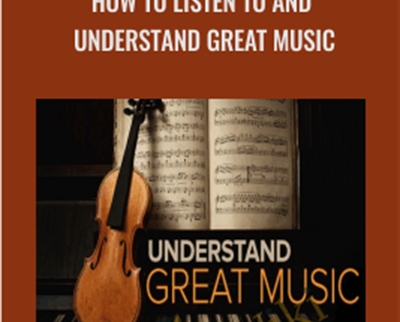
Learning how to appreciate the unmatched beauty, genius, and power of concert music can permanently enrich your life. Why is this so? As award-winning composer and Professor Robert Greenberg explains, "Music, the most abstract and sublime of all the arts, is capable of transmitting an unbelievable amount of expressive, historical…
Unlock Your Potential with the How to Listen to and Understand Great Music – Robert Greenberg course only Original price was: $599.95.$68.00Current price is: $68.00. on CoursesGB!
At CoursesGB, we provide over 60,000 downloadable digital courses designed for your personal and professional growth. Get expert-guided, self-paced learning at an unbeatable value – often over 80% off original prices. The How to Listen to and Understand Great Music – Robert Greenberg offers practical insights and proven strategies for all skill levels.
Enroll now and elevate your learning with CoursesGB!
What Will You Learn?
- Examine the contributions of nearly every major composer, including Bach, Mozart, Beethoven, Stravinsky, and more.
- Go deep inside the most magnificent pieces of Western concert music with the aid of digitally recorded musical passages.
- Gain an outstanding grasp of musical forms, techniques, and terms – and finally become fluent in the language of music.
- Discover the powerful influence of social context on musical creation from ancient Greece to the 20th century.
- Learn the characteristics of every major concert music form that developed in Europe over the last 2,000 years.
Learning how to appreciate the unmatched beauty, genius, and power of concert music can permanently enrich your life. Why is this so? As award-winning composer and Professor Robert Greenberg explains, "Music, the most abstract and sublime of all the arts, is capable of transmitting an unbelievable amount of expressive, historical, and even philosophical information to us, provided that our antennas are up and pointed in the right direction. A little education goes a long way to vitalizing and rendering relevant a body of music that many feel is beyond their grasp.
"And why is an understanding of concert music worthwhile? I would suggest a few reasons:
“The skills one brings to listening to music—imagination; abstract, nonconcrete thinking; intuition; and instinctive reaction and trusting those instincts—have gone uncultivated in our educational system and culture for too long.
“Music, as a universal, nonverbal language, allows us to tap into the social, cultural, and aesthetic traditions of different cultures and historical eras. We become more aware of our shared humanity and the wisdom and vision of others.
“Music allows us to transcend our own world and partake in utterly different realities.
“Last, but certainly not least, good music is fun to listen to, relatively inexpensive—we can do it by ourselves or with others—and there are any number of ways to expand our knowledge and appreciation of the art."
The Tools, the Times, the Composers, and Their Music
Grammar: Professor Greenberg gives you an outstanding grasp of musical forms, techniques, and terms—the grammatical elements that make you fluent in the language of music. These are not dull concepts. Professor Greenberg alerts us to the need for them:
"Music, like any pseudoscience, requires an adjectival palette by which we can isolate events that without proper terms we might not even be able to notice. It's an interesting question to what degree language allows us to perceive things that are not language-associated. I'm a strong believer that if you've got the right word to identify something, you can perceive it. I think my favorite pseudoscience when it comes to this kind of thing is wine-tasting, where one has to come up with an adjectival palette that is almost a cartoon unto itself. But silly as these phrases may be—'Oh, this has a hint of young tobacco, and old oak fragrant with raspberries'—silly as these terms are, they allow us to draw distinctions without which we may not be able to draw at all. So we will create a useful vocabulary."
Rich Context: Professor Greenberg teaches the powerful influence of social context on musical creation. Bestselling author James Collins, writing in Inc. magazine, explains: "The Greenberg series combines a history of Western civilization with a history of great music from ancient Greece to the 20th century. Greenberg's 48 lectures come alive with passion and knowledge. The course illustrates the interplay between societal change and innovation and offers a unique perspective on the acceleration of change wrought by the 20th century."
Professor Greenberg's lectures show how musical creativity has provided, throughout the history of our civilization, a vibrant means of expression for grand spiritual, intellectual, political, social, and economic forces.
Whether it's the profound influence of Lutheran spirituality on Bach or the effect of the French Revolution on Beethoven (to give just two examples), you'll see how such forces have swirled through the lives of music's creators and listeners in various historical epochs. You'll also grasp how these forces have stimulated the creation of musical masterpieces that are both transcendent works of art and compositions deeply rooted in their respective eras, telling us something central about the human condition in each one.
The Composers: The course examines the contributions of nearly every major composer. But one of Professor Greenberg's aims is to make their music accessible, and, for this, we must accept that every one of them was human and no more. (He observes at one point that an English translation of the name Giuseppe Verdi would be simply "Joe Green.") You will remember their music, and you will never forget the composers who are brought to life throughout the lectures. Consider Professor Greenberg's introduction to Berlioz:
"Hector Berlioz begins writing the Symphonie fantastique in 1829 and he completes it in 1830, the same year he graduates from the conservatory, so he's only 27 years old and still learning his craft.
"The Symphonie fantastique is an experimental artwork if there ever was one. It is an absolutely avant-garde piece of music. It attempts to unite the four great loves of Berlioz's life, as he felt them then and as they continued to be throughout his life. Those four great loves, in no particular order, are: first, Shakespeare's plays and Shakespeare's sense of drama; second: Beethoven's symphonies, which Berlioz worshipped; third: opera, which Berlioz lived for; and we must not forget the fourth great love of Berlioz's life: himself. It's a very autobiographical work. Again, we have to understand that autobiography is very typical of the self-involvement and expressive self-indulgence of the 19th- and indeed, the 20th-century artist."
The Music: Using digitally recorded musical passages to illustrate his points, Professor Greenberg will take you inside magnificent compositions by Bach, Handel, Haydn, Mozart, Beethoven, Chopin, Verdi, Wagner, Brahms, Tchaikovsky, Stravinsky, and more. You have listened to many of the illustrative pieces all your life—you will never hear them the same way again after Professor Greenberg has opened them up. Look at the titles of the lectures in this course to see how much you'll learn.
48 lectures | Average 45 minutes each
- Music as a Mirror
- Sources—The Ancient World and the Early Church
- The Middle Ages
- Introduction to the Renaissance
- The Renaissance Mass
- The Madrigal
- An Introduction to the Baroque Era
- Style Features of Baroque-era Music
- National Styles—Italy and Germany
- Fugue
- Baroque Opera, Part 1
- Baroque Opera, Part 2
- The Oratorio
- The Lutheran Church Cantata
- Passacaglia
- Ritornello Form and the Baroque Concerto
- The Enlightenment and an Introduction to the Classical Era
- The Viennese Classical Style, Homophony, and the Cadence
- Classical-era Form—Theme and Variations
- Classical-era Form—Minuet and Trio: Baroque Antecedents
- Classical-era Form—Minuet and Trio Form
- Classical-era Form—Rondo Form
- Classical-era Form—Sonata Form, Part 1
- Classical-era Form—Sonata Form, Part 2
- Classical-era Form—Sonata Form, Part 3
- The Symphony—Music for Every Person
- The Solo Concerto
- Classical-era Opera—The Rise of Opera Buffa
- Classical-era Opera, Part 2—Mozart and the Operatic Ensemble
- The French Revolution and an Introduction to Beethoven
- Beethoven's Symphony no. 5 in C Minor, op. 67, Part 1
- Beethoven's Symphony no. 5 in C Minor, op. 67, Part 2
- Introduction to Romanticism
- Formal Challenges and Solutions in Early Romantic Music
- The Program Symphony—Berlioz's Symphonie fantastique, Part 1
- The Program Symphony—Berlioz's Symphonie fantastique, Part 2
- 19th-Century Italian Opera—Bel Canto Opera
- 19th-Century Italian Opera—Giuseppe Verdi
- 19th-Century German Opera—Nationalism and Experimentation
- 19th-Century German Opera—Richard Wagner
- The Concert Overture, Part 1
- The Concert Overture, Part 2
- Romantic-era Musical Nationalism
- Russian Nationalism
- An Introduction to Early 20th-Century Modernism
- Early 20th-Century Modernism—Claude Debussy
- Early 20th-Century Modernism—Igor Stravinsky
- Early 20th-Century Modernism-Arnold Schonberg
Get How to Listen to and Understand Great Music – Robert Greenberg, Only Price $72
Tag: How to Listen to and Understand Great Music – Robert Greenberg Review. How to Listen to and Understand Great Music – Robert Greenberg download. How to Listen to and Understand Great Music – Robert Greenberg discount. great courses listen understand great music. how to listen to and understand great music download. how to listen to and understand great music dvd. how to listen and understand great music pdf. how to listen to and understand great music 1st edition
Unlock Lifetime Learning and Career Growth with the How to Listen to and Understand Great Music – Robert Greenberg course only Original price was: $599.95.$68.00Current price is: $68.00. at CoursesGB!
Invest in your future with the How to Listen to and Understand Great Music – Robert Greenberg course at CoursesGB and gain immediate, lifetime access to expertly crafted digital content designed to boost your career and personal development. As a leading platform for downloadable courses, we offer unparalleled value and convenience.
Why Choose CoursesGB?
- Lifetime Access: Enjoy unlimited access to your purchased courses, forever.
- Massive Savings: Get top-tier courses at prices up to 80% lower than original sales pages.
- Secure Payments: Shop with confidence using our secure payment methods (PayPal, Stripe).
- Practical Knowledge: Empower your career with actionable, real-world skills from over 60,000 diverse courses.
- Instant Access: Start learning immediately after purchase via your account dashboard or email for most courses.
- Learn Anywhere: Access your courses seamlessly on any device (desktop, mobile, tablet).
Start your learning journey today and discover the CoursesGB advantage!
Only logged in customers who have purchased this product may leave a review.
Related products
Uncategorized
Original price was: $199.99.$85.00Current price is: $85.00.
Original price was: $299.99.$94.00Current price is: $94.00.
Uncategorized
Original price was: $199.99.$85.00Current price is: $85.00.
Uncategorized
Managing Geriatric Behaviors: Wandering, Aggression, Malnutrition and More – Steven Atkinson
Original price was: $59.99.$35.00Current price is: $35.00.
Reviews
There are no reviews yet.